Three Weeks Out: Early Developments After Rescheduling
On Thursday, April 23, 2026, the U.S. Department of Justice (DOJ) released its final order rescheduling certain marijuana products from Schedule I to Schedule III of the Controlled Substances Act (CSA). After publication in the Federal Register on Tuesday, April 28, 2026, the order became effective. Federal agencies, state governments, and businesses alike continue to wrestle with the legal, financial, and commercial implications of the order.
The Rescheduling Order Has Been Challenged in Federal Court
On Monday, May 4, 2026, nonprofit organizations Smart Approaches to Marijuana, Inc. and the National Drug and Alcohol Screening Association, Inc. jointly filed a petition in the U.S. Court of Appeals for the District of Columbia Circuit requesting the review and setting aside of the DOJ’s rescheduling order. The petition, which comes less than a week after the order became effective, argues the order’s invalidity on four grounds:
1. The order violates the Administrative Procedure Act, which sets out notice-and-comment requirements that apply to scheduling actions under the CSA.
2. The order violates the CSA, which sets out requirements for rulemaking procedures required for scheduling actions.
3. The order exceeds the statutory authority of the U.S. Attorney General under the CSA.
4. The order lacks a rational connection between facts found by the DOJ and its decision to reschedule marijuana, rendering the order arbitrary and capricious.
Notably, the petition did not request expedited relief in its initial filing, but it is possible that expedited relief may still be requested. Proceedings related to the appeal are currently set to commence on Thursday, June 4, 2026, only weeks before the administrative hearing on broader marijuana rescheduling issues scheduled for Monday, June 29, 2026.
The Application for DEA Registration is Now Live; More to Follow
The rescheduling order instructed medical marijuana businesses to register with the Drug Enforcement Administration (DEA). The application for such DEA registration is currently live via their Marijuana Dispensary Registration Portal. Note that this application (Form 224-MMP) is only for dispensaries.
Although no site login is required to access and submit the application, DEA’s acceptance of applications is limited to those from either (1) active operators in state-licensed medical marijuana programs or (2) individuals and entities handling or seeking to handle FDA-approved drug products containing medical marijuana.
The application has seven total sections:
1. Personal or Business Information Identifying the Applicant
2. Indication of Types of Marijuana the Applicant Seeks to Handle
3. Applicant’s State License Information
4. Previous Civil, Criminal, and Other Disciplinary Actions Against the Applicant
5. Additional Details Concerning Applicant’s Current Operations and Compliance Efforts
6. Payment
7. Submission
Five of the seven sections require substantive disclosures, including:
- whether the applicant handles adult-use marijuana in addition to medical marijuana
- whether anyone associated with the applicant has previously manufactured, distributed, and/or dispensed any controlled substance without a DEA registration authorizing such activity
- a list of every supplier from which the applicant intends to procure marijuana products by name and address
- identification by name, title, date of birth, social security number, and criminal history of every individual associated with the applicant that will have access to medical marijuana.
A $794 non-refundable application fee must be submitted in conjunction with the application. Although initial application instructions listed PayPal as the only acceptable form of payment, current instructions now include ACH payments.
Other medical marijuana operators—cultivators, manufacturers, testing facilities—may use DEA Form 225 to apply for DEA registration. This form is not specific to any particular controlled substance. Despite the availability of this form, the DEA has reported that it will be releasing “updated” applications for “Medical Marijuana Manufacturer[s],” “Medical Marijuana Bulk Manufacturer[s] (grower/cultivator),” “Medical Marijuana Distributor[s],” and “Medical Marijuana Analytical Lab[s].” In contrast to the general Form 225, which requires selection of applicable drug codes corresponding to marijuana, these applications will be available “specifically for handling Schedule III medical marijuana.” DEA Form 225 is not available for medical marijuana dispensaries.
It is unknown how the forthcoming medical marijuana-specific applications will differ in substance, but the DEA Diversion Registration page indicates that their respective annual registration fees will be consistent with their current non-marijuana counterparts: $3,699 for medical marijuana manufacturers (both bulk and otherwise), $1,850 for medical marijuana distributors, and $296 for medical marijuana analytical labs.
Applicants will notice the definitional incongruity between state medical marijuana programs and DEA registration. Pursuant to the rescheduling order and its codification into federal regulation, DEA registration for medical marijuana operations is available for manufacturers and distributors (in addition to dispensers covered by Form 224-MMP, discussed above).
“Manufacturers” are permitted to “cultivate, produce, process, package, label, and transfer marijuana and products containing marijuana to registered distributors or other registered manufacturers, subject to the limitations of its state license.” This definition captures activities that, under many state programs, are performed separately by either processing license holders or cultivation license holders, but under state law, neither of these registrants would normally be permitted to conduct the activities of the other. The DEA’s announcement of separate upcoming applications for “Medical Marijuana Manufacturer[s]” and “Medical Marijuana Bulk Manufacturer[s] (grower/cultivator)” suggest that the DEA may nonetheless seek to maintain the state-level separation, ushering cultivators to the bulk manufacturer license and the products manufacturers to the non-bulk manufacturer license.
“Distributors” are permitted to “receive marijuana and products containing marijuana from registered manufacturers and transfer marijuana and products containing marijuana to registered dispensers or other registered distributors.” In other words, distributors are transfer agents, which may include those licensed by state medical marijuana programs to solely transport medical marijuana and manufacturers that ultimately transfer marijuana products to dispensaries. The forthcoming distributor license application will hopefully shed light on whether those with a Medical Marijuana Manufacturer or Medical Marijuana Bulk Manufacturer license will also need a Medical Marijuana Distributor license if they are delivering medical marijuana or marijuana products to dispensaries.
Finally, even though federal regulation post-rescheduling makes no mention of DEA registration for medical marijuana testing labs, the DEA’s announcement of forthcoming registration applications included reference to “Medical Marijuana Analytical Lab[s].” Likewise, new federal regulation provides no definition for such operators or details on permitted activities for them. We are hopeful that the release of additional, medical marijuana-specific applications will provide clarity on this, as well as on other matters noted above.
Treasury and IRS Say Guidance is Forthcoming
Responding to the tax implications mandated by the DOJ’s rescheduling order, the U.S. Department of the Treasury (“Treasury”) and Internal Revenue Service (IRS) have announced that guidance for affected businesses is forthcoming. The Treasury and IRS have stated they anticipate “significant positive tax consequences” for businesses affected by the rescheduling order. To this end, they plan to issue guidance concerning at least two key tax issues raised by rescheduling:
1. clarity on how “section 280E applies only to those business activities related to trafficking in Schedule I or II controlled substances (e.g., by apportioning expenses)”
2. a transition rule that limits the tax benefits of rescheduling to “a business’s full taxable year that includes the effective date of the Final [rescheduling] Order.”
This second point is seemingly necessary because the rescheduling order’s effective date appears to mark the point at which impacted businesses’ activities cease to involve Schedule I or II controlled substances that subject them to 280E liability, but appears to ignore the rescheduling order’s suggestion that the IRS “provid[e] retrospective relief from Section 280E liability for taxable years in which a state licensee operated under a state medical marijuana license.”
Although no other federal agency has followed Treasury and IRS’s lead in advising that additional guidance is forthcoming, we anticipate such additional guidance as affected federal agencies fully digest the rescheduling order.
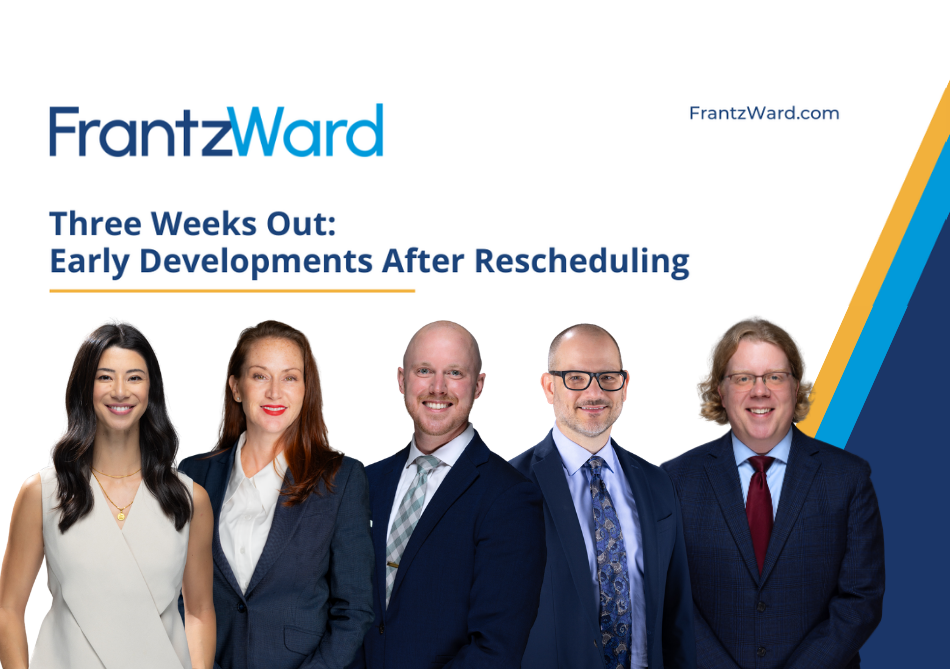
Frantz Ward cannabis attorneys Mia Garcia, Jean Smith-Gonnell, Tom Haren, Jim Ickes, and Keenan Jones are ready to answer any questions you may have about marijuana rescheduling, how it impacts your business, and how to navigate any regulatory changes. Special thanks to Summer Associate Diana Rosales for her research and drafting assistance on this client update.
This post is for general information and does not constitute legal or tax advice. If you have questions about how these recent rescheduling developments affect your business, please do not hesitate to reach out to one of the members of the Frantz Ward Cannabis Law and Policy team.